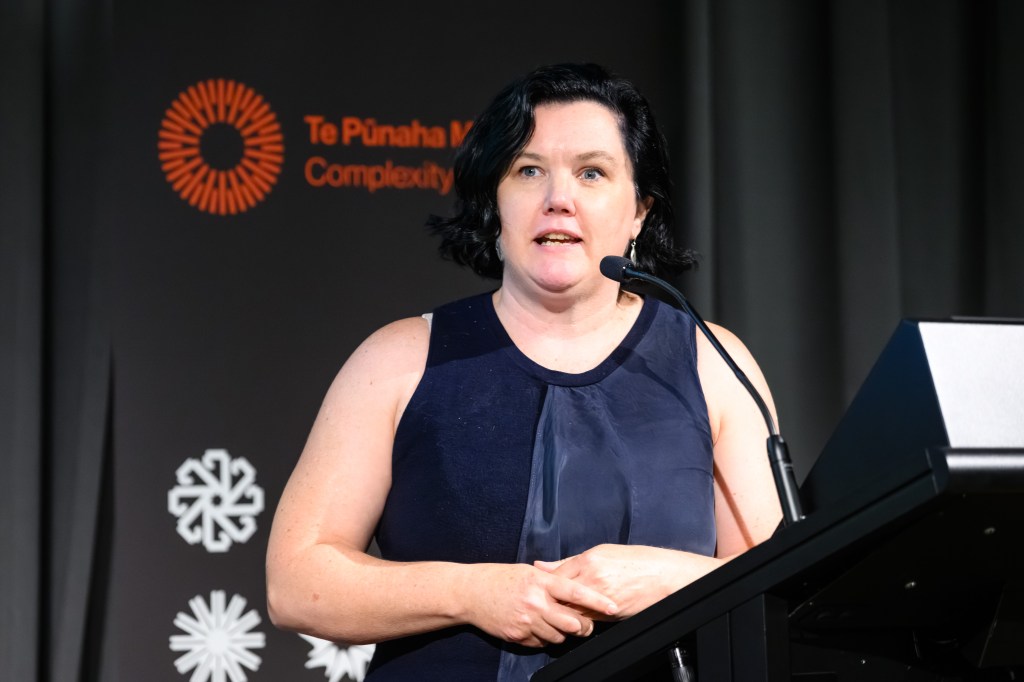
In February Sharon presented on behalf of the team at the Capital Cities Complex Systems Symposium in Wellington. This was a very diverse conference, with theoretical perspectives on complexity and practical applications, and examples drawn from health, climate and environment, infrastructure, education, artificial intelligence and more.
Sharon’s presentation highlighted the Magimagi framework, which conceptualises the diverse components of the health system as strands woven into a rope. This metaphor highlights the strength created through interconnection and offers a more holistic way of understanding health systems, bringing attention to relationships and other elements that are often overlooked in conventional models (see abstract below).
The presentation was less technical than many others but resonated with a key thread running through the conference: Indigenous perspectives on complex systems. Several presentations highlighted Māori approaches to systems change, relational thinking, and community-led solutions. This grounded complexity in lived experience and local knowledges, and illustrated how systems thinking aligns with Indigenous worldviews. In particular, researchers from Whakaue (an iwi-owned research centre in Aotearoa) gave a beautiful presentation on Te Ruru – an Indigenous systems change framework, and Prof. Tom Roa and Rodrigo Hill presented on Ūkaipō: A networked Indigenous approach to research, place and photographic representation.
We also appreciated the keynote by Diane Finegood, Confessions of a recovering reductionist: Towards systems thinking in practice, in which she explored the difference between complex and complicated and the link to the free eBook she has written, an Illustrated Complex Systems Frameworks Collection (and our well-used complex adaptive loop is in there, along with many others).
A big thanks you to the organisers, Te Pūnaha Matatini, for bringing together such a thoughtful and engaging programme, and for creating space for a wide range of perspectives and conversations. It was an inspiring few days, and we hope to continue these discussions in the coming year.
The Health System magimagi: An indigenous perspective on complex systems
Abstract
The COVID-19 pandemic exposed vulnerabilities in health systems worldwide, often exacerbating pre-existing systemic challenges. This paper draws from research examining change in Fiji’s health system, exploring the adaptive practices that emerged in response to crises and indigenous and context-sensitive pathways for resilience and transformation. In this paper we present the conceptual framework for this research, which integrates complex adaptive systems theory with the Fiji Vanua and Tali Magimagi research frameworks. This framework draws on the imagery and cultural practice of magimagi: where strong, durable, fine coconut fibres are woven together and used to build canoes, bure (houses), fish traps, and ceremonial spaces. More than just a rope, magimagi is a sacred, ancestral technology reflecting deep cultural knowledge, purposeful design, and intergenerational wisdom.
In this framework, we conceptualise the diverse components of the health system as threads in the magimagi. Through talitali (the act of weaving) these diverse elements are brought into meaningful interdependence. The more strands added with precision, the greater the rope’s tensile strength, flexibility, and resilience. This mirrors the complex adaptive nature of resilient health systems, which must absorb shocks, adapt to uncertainty, reorganise in the aftermath of crises, and evolve to meet emerging needs. Nevertheless, such durability is not inherent; it is earned through the quality of the weaving – through collaboration, community ownership, and mutual respect. When the weaving is rushed or incomplete, the rope frays. However, when the weaver pays attention to all strands, even the ones unseen or undervalued, the rope endures.
In conceptualising the health system as magimagi, we weave Indigenous Fijian values and epistemologies into the forefront of systems thinking. This is a holistic framework that emphasises the interconnectedness of components often overlooked in conventional health system models, and thus provides a decolonised, context-sensitive approach to health system resilience.
 Exploring Fijian Health System Resilience