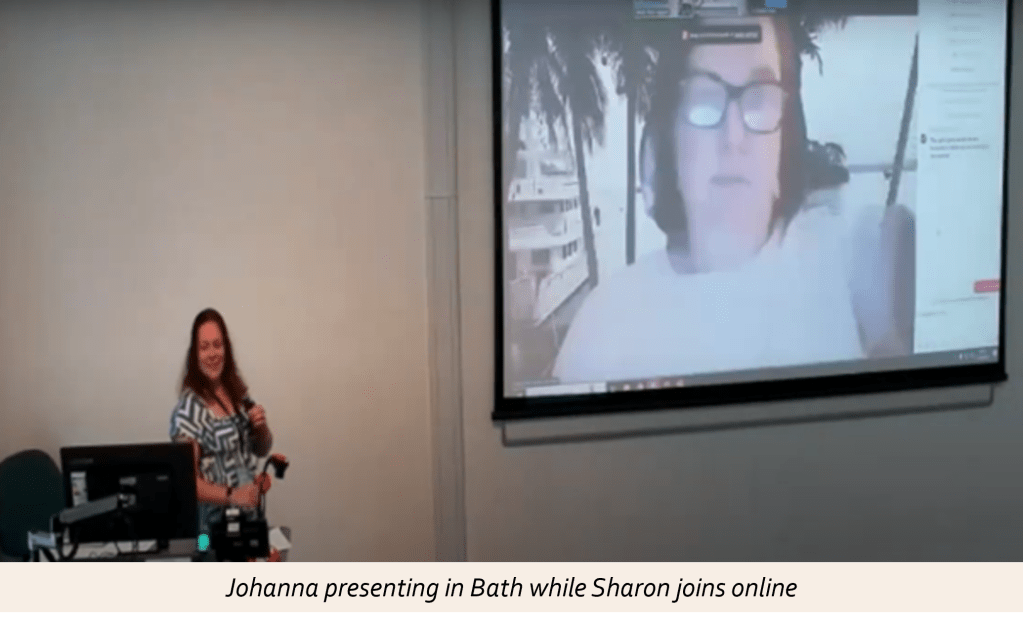
From 25th to 27th June 2025, the annual Development Studies Association (DSA) conference was held at the University of Bath in the United Kingdom. Under the theme Navigating Crisis: Dangers and Opportunities in Development, the conference explored how development theories and practices engage with ongoing crises and uncertain futures, and what opportunities might arise for more just and transformative systems.
Our postdoctoral fellow, Dr Johanna Thomas-Maude attended in person in Bath, while Primary Investigator Dr Sharon McLennan joined virtually from Fiji, where she is undertaking a second round of talanoa discussions as part of our ongoing health system resilience project.

Day One: Stories as Resistance and the Power of Reflexivity
The opening keynote by Professor Akosua Adomako Ampofo (University of Ghana) set a hopeful tone. In a talk titled Surprising Joy in Times of Crippling Fear, she spoke of storytelling as an act of resistance and a way of cultivating hope. She called on researchers to engage in knowledge-making that builds joy in community – not to obscure crisis, but to transform how we respond to it and avoid the paralysis of fear.
Johanna also attended two interesting sessions that afternoon. The first, Breaking the Mould: Seeking Equity Through Reforging Mechanisms for ‘North-South’ Research Collaborations, interrogated the language of “equitable partnerships” and challenged whether this term has become more symbolic than substantive. Speakers advocated for more relational rather than transactional collaborations, with suggestions such as translating article abstracts into local languages and critically reflecting on whether “decolonising” frameworks can be achieved from within Western epistemologies.
In the second session Johanna attended, Re-reading ‘Stories-So-Far’, presenters examined the risks and rewards of storytelling in reflexive research. While narrative vignettes can offer important insight, they can also risk reinforcing idealised or sanitised memories. Reflexivity, it was argued, must push beyond “virtuous” self-awareness to critically challenge the deeper assumptions we hold.
Day Two: Fijian Health System Resilience and Cross-Cultural Resonance
Day two began with Sharon’s online presentation, Reimagining Health System Resilience in Fiji: Lessons from COVID-19 and Beyond. Drawing on our group talanoa sessions from February with health sector stakeholders, nurses, and community leaders, the presentation introduced our approach and evolving Tali Magimagi framework that integrates Indigenous Fijian knowledge with complex adaptive systems theory (see Our Findings).

Audience members asked thoughtful questions about applying this framework beyond the health sector, especially in small, interconnected contexts like Fiji. There was also strong appreciation for the framework’s grounding in Indigenous Fijian metaphors – one audience member noted a connection to ancient rope weaving practices in Celtic Britain, highlighting how localised concepts can also resonate in international contexts.
Day Three: Stories of Loss, Grief, and Enduring Care
The third day opened with Johanna’s presentation titled Difficult Deaths, Unfinished Mourning: The Experiences of Frontline Healthcare Workers During and After the COVID-19 Crisis in Fiji. Drawing from our talanoa sessions with healthcare workers in February, she explored the emotional and cultural complexities of caring for the dying during the pandemic, often without family present, and the disruption of traditional mourning practices. Questions from the audience presentation drew attention to the concept of “grievability” and the need for stronger support systems for frontline workers, both during and after crisis.

Next, Sharon and Johanna attended a keynote from Professor Yuen Yuen Ang, who introduced the concept of the Adaptive, Inclusive, and Moral (AIM) Political Economy. She critiqued dominant narratives of “polycrisis” as often Western-centric abstractions, instead calling for grounded systems thinking that highlights Indigenous innovation and the creative repurposing of local resources.
Looking Ahead
This year’s DSA conference reinforced the value of storytelling as both a method and a mindset in development research. It also offered rich provocations about cross-sectoral resilience, reflexivity, and the importance of drawing on Indigenous knowledge systems to reimagine the future. As Sharon continues fieldwork in Fiji, and as analysis of the talanoa transcripts progresses, we look forward to deepening these conversations and sharing further insights – both within and beyond the health system.
 Exploring Fijian Health System Resilience